• We have updated to the newest version of the forum. Please let us know if you see any issues. And, yes, we know the shoutbox is gone. We'll see about getting it back if they make a newer version.

Math help (basic to advanced)

dmention7

Hater
Ok this web assign has got me trippin.

Solve this for x.

(5/6)x - 2 = (4/5)x + 4/6

Subtract (4/5)x from both sides, and add 2 to both sides

(5/6)x - (4/5)x = 4/6 + 2

At this point all you need to do is convert the fractions to a form that have the same denominator by multiplying the terms by a fraction equal to 1

(5/5)*(5/6)x - (6/6)*(4/5)x = 4/6 + (6/6)*2

Which simplifies to

(25/30)x - (24/30)x = 4/6 + 12/6

x/30 = 16/6

multiply both sides by 30 and simpify

x = 80
 

dmention7

Hater
Solve the equation, if possible. (If the equation is an identity or a contradiction, so indicate by entering IDENTITY or CONTRADICTION.)

Start by expanding the x term on the left... (x+2)/5 --> x/5 + 2/5

5 - (x/5 + 2/5) = 7 - x

Group the x terms to the left side, and simplify

-x/5 + x = 7 -5 + 2/5

(4/5)x = 12/5

4x = 12

x = 3
 
Z

Z-licious

Guest
multiply by 20 (5 x 4)

10(x-5) - 4(x-7) >= -5x

multiply through

10x - 50 - 4x + 28 >= -5x
6x - 12 >= -5x

add 5x and 12 to both sides (5x + 12)

11x >= 12

divide both sides by 11

x >= 12/11
 
Z

Z-licious

Guest
That's because I made a mistake:

10x - 50 - 4x + 28 >= -5x
6x - 12 >= -5x


Should have simplified to:

6x - 22 >= -5x

So add 5x and 22 to each side (5x + 22)

11x >= 22

divide both by 11 to get

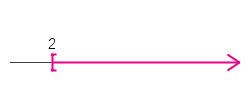
x >= 2 or [2,infinite)
 

Jana

New Member
I'm back in college, and taking College Algebra (week 3)....and extremely lost. Would anyone have time to help today, if I post up the question? Anyone interested in coming over & tutoring me? :)
 

Jana

New Member
Here are the ones I'm stuck on currently:

(Graphs, Lines & Inequalities is the chapter)

Find an equation for each of the following lines:
1) Undefined slope, through (-1,4)
2) x-intercept -3, y-intercept 5

Solve each inequality:
1) 2(3-2m) greater than or equal to 8m+3 (couldn't get the symbol for the greater than or equal posted)
2) |b| less than or equal to 8
3) |5k+2|-3 less than or equal to 4

I have to show my work, as that's where I get the points. The answers are provided, but don't help me as I don't understand the material....

Any help is greatly appreciated!!
 

FunK73

New Member
Number 1) Undefined slope means that it is a vertical line, thus that lines equation is X=-1
Number 2) It might look like they only gave you 2 points, but they are actually co-ordinates, (-3,0) and (0,5). Using these co-ordinates you can use the slope equation (y2-y1)/(x2-x1) to find the slope, and the y intercept is given so that equation is y=-(5/3)+5

As far as the inequalities go, I think you have to just solve them for the variable using algebra (moving things to other sides of the inequality side till the variable is alone). So the first one, 2(3-2m)>8m+3. You want to solve for m, so start by dividing the whole thing by two. This makes the equation 3-2m>4m+(3/2). From there its just a matter of moving things around using addition and subtraction. you'll end up with (3/2)>6m. Then you simply divide by the number attached to m, so you'll get 1/4>m.

All those signs should be greater than or equal to.

Hope this helps!
 

Jana

New Member
Number 1) Undefined slope means that it is a vertical line, thus that lines equation is X=-1
Number 2) It might look like they only gave you 2 points, but they are actually co-ordinates, (-3,0) and (0,5). Using these co-ordinates you can use the slope equation (y2-y1)/(x2-x1) to find the slope, and the y intercept is given so that equation is y=-(5/3)+5

As far as the inequalities go, I think you have to just solve them for the variable using algebra (moving things to other sides of the inequality side till the variable is alone). So the first one, 2(3-2m)>8m+3. You want to solve for m, so start by dividing the whole thing by two. This makes the equation 3-2m>4m+(3/2). From there its just a matter of moving things around using addition and subtraction. you'll end up with (3/2)>6m. Then you simply divide by the number attached to m, so you'll get 1/4>m.

All those signs should be greater than or equal to.

Hope this helps!
I still don't get the moving around of things.... any chance you can explain it line by line of what's done?
 

Workdawg

NARWHAL
It's just the same as solving for a variable, except the sign isn't =, its <, > , etc...

starting -- 3-2m > 4m+(3/2)
adding 2m to both sides -- 3 > 6m + (3/2)
subtracting 3/2 from both sides -- 3-(3/2) > 6m --(3 - (3/2) = 3/2... so it's now 3/2 > 6m)
divide by 6 -- (3/2) / 6 > m equals 1/4 > m
 

Jana

New Member
Anyone want to help with a couple more questions? Here they are....

1) Write each statement using mathematical symbols: a) n is the product of difference between n squared ans seven, and n cubed b) ten less than the quotient of n and the difference between n and six.

2) Solve for x by completing the square: x^2+6x=2

3) Simplify: (x^-7 y^11 z^14)^-2

Thanks!
 

Workdawg

NARWHAL
I'll take the first one.

1)
The wording ones are kinda tricky, but you have to look for where it says "and" to see which numbers are supposed to be applied to each other with the given operator. If you see an operator, you have to look for the and directly after it. On one side of the and is the first number to apply, on the other side of the operator is the other number. If you see a second operator on the other side of the first, then you have to figure out what's there before going back to the first. My explanation is bad, so I tried to work it out below.

"is" is =
product is multiple
difference is subtract
sum is add
quotient is divide

a)
1. "n is" --- n =
2. "the product of the difference between n squared and 7, and n cubed" --- there are two operators here, so we have to figure out the second one first...
3. "the difference between n squared and 7" --- (n²-7)
then we can go back to 2...
4. "the product of the difference between n squared and 7, and n cubed " --- from 3, we know "the difference between n squared and 7" is (n²-7), so we can plug that into the rest of this... so, its "the product of (n²-7), and n cubed" --- n²-7 * n³
5. put it all together --- n = n² - 7 * n³

b) 10 < (n/n-6)
"ten less than" --- 10 <
"the difference between n and six" --- n-6
"the quotient of n and the difference between n and six" --- n/n-6

 
Z

Z-licious

Guest
2) Solve for x by completing the square: x^2+6x=2
x^2 + 6x = 2

add to both sides the square of half of the coefficient of x, which is 3^2 or 9

x^2 + 6x + 9 = 2 + 9

This allows you to convert to this form

(x + 3)^2 = 11

you can check your work by multiplying back out. If everything looks ok, then you take the square root of both sides

x + 3 = +-√11 (+- means plus or minus)

x = -3 +-√11
 

Jana

New Member
x^2 + 6x = 2

add to both sides the square of half of the coefficient of x, which is 3^2 or 9

x^2 + 6x + 9 = 2 + 9

This allows you to convert to this form

(x + 3)^2 = 11

you can check your work by multiplying back out. If everything looks ok, then you take the square root of both sides

x + 3 = +-√11 (+- means plus or minus)

x = -3 +-√11
Huh?
 
Top