• We have updated to the newest version of the forum. Please let us know if you see any issues. And, yes, we know the shoutbox is gone. We'll see about getting it back if they make a newer version.

Math help (basic to advanced)

dmention7

Hater
Okay, for this one, there are a couple of different ways you can think about it. Remember that 2(-3c - 4)(4.4) really means 2 * (-3c - 4) * (4.4)

Also remember that multiplication can be performed in any order and that the parentheses just mean that whatever is inside them is treated as a group by anything outside the parentheses. So that (4.4) is the same as 4.4, and you can rewrite the whole thing as 2 * 4.4 * (-3c - 4)

Here is one way to proceed:

2 * 4.4 * (-3c - 4)
8.8 * (-3c - 4)
-26.4c - 35.2


The other way to proceed is

2 * 4.4 * (-3c - 4)
2 * (-13.2c - 17.6)
-26.4c - 35.2


In the second way I multiplied 4.4 * (-3c - 4) first. I left the result inside parentheses, since the whole thing still needed to be multiplied by 2

This might be getting ahead of what you guys are doing, but since multiplication can be performed in any order, all of the following expressions mean the same thing:

a * b * c
(a * b) * c
a * (b * c)
(a * c) * b
etc....
 
Last edited:

dmention7

Hater
aha, now we're getting into algebra with numerical answers like James prefers! lol

when solving for variables like this, you have to look for a route in which you end up with the variable by itself on one side of the equation, and a number on the other side. One of your main tools is by sequentially adding and/or multiplying BOTH sides of the equation. As long as you do the same operation to the entire left side and the entire right side, the equality is still true.

In this case, start by adding 5 to both sides, so that the "-5" term disappears from the left side:

n/5 - 5 + 5 = 3 +5 --> n/5 = 8

Now multiply both sides by 5 so that the left side is just n by itself:

(n/5) *5 = 8*5 --> n = 40
 

dmention7

Hater
No, we are still following the order of operations. I can't think of a good way to explain it in writing without sounding confusing, but it doesn't apply to the order in which you can take steps towards solving an equation.... it only tells you which operations to do first when you are actually simplifying an expression. Kind of like imaginary parentheses.
 

Big Nate

Chaos Engineer
A bicycle path is 7 miles long. A man walks from one end at the rate of 2 mph. At the same time, a friend bicycles from the other end, traveling at 26 mph. In how many minutes will they meet?
 
H

Hot Ice

Guest
Subtract 1/4 from both sides so you are left with
3/8 - 1/4 = d/7
Change 1/4 to 2/8 to make common denominators and subtract to get...
1/8 = d/7
then you need to multiply both sides by 7 to leave d by itself
7/8 = d
that should work for you
 

dmention7

Hater
A bicycle path is 7 miles long. A man walks from one end at the rate of 2 mph. At the same time, a friend bicycles from the other end, traveling at 26 mph. In how many minutes will they meet?
So, you want to figure out when the two men have traveled a combined distance of 7 miles, and distance is equal to speed * time.

So, 2*t + 26*t = 7 , where t is the time in hours (since their speeds are given in miles/hour)

Combining the t terms, 28*t = 7 --> t = 7/28 = 1/4 hours = 15 minutes
 

dmention7

Hater
the top of the right side should be -4c - 10

But, to move on you've got to make the denominators (bottom number) of both sides equal. The easiest way to do this is as follows:

Say you've got a/x = b/y
You need to multiply the left side by y/y, and the right side by x/x. This is allowed because y/y = x/x = 1. So all you're doing is multiplying both sides by 1, but in a way that makes the equation easier to solve.

Anyways, back to your problem... If you multiply the left side by 7/7 and the right side by 2/2, you get


or


See if you can take it from there
 

Workdawg

NARWHAL
You made a little error above... it should be -4c - 10 on the right side... looks like you added the -2 to the 5, instead of multiplied. Note also that the multiplying will change the sign to a negative.

It should be :


The next step I would make is to seperate out the fractions...


Now you can move all of the parts around so c is alone on its own side...


Now the tricky part is combining the fractions, to do this, you need to make common demoninators... looks like in this case that's 14... so multiply each fraction that has a 2 in the denominator by 7/7 and each fraction that has 7 in the denom by 2/2 (you can do this because 7/7 and 2/2 both equal 1, so really you aren't changing the value at all, just making common denoms)

See here the forum hates it

Multiply that all out and all fractions should have 14 on the bottom so you can add them together.


Now just add it together.
 
Last edited by a moderator:

Big Nate

Chaos Engineer
This is a cut and paste of the question he emailed everyone.


Bonus Points Available via email address!!!
Bring this problem to class with a correct solution for bonus points!

3/5 + 7/z = Show your work and use the correct z, of course!!!
 

dmention7

Hater
I bet he just phrased the question strangely. I think what you need to do is just simplify the expression into a single fraction... in which case, all you need to do is this:


and then multiply through and simplify
 

Big Nate

Chaos Engineer
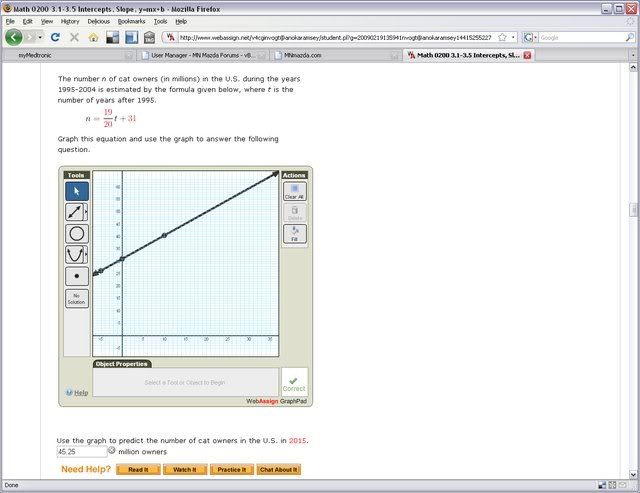
Can someone please check my work here.


Did I not do something correctly?

Sorry for the small size. But you can just plug the numbers in and get the answer.
 

dmention7

Hater
I'm not sure what you did wrong, but I get a different answer.

First find t for the year 2015: t=2015-1995=20

Then plug in t: N = (19/20)*20 + 31 = 19 + 31 = 50
 

dmention7

Hater
No, the problem states that t is the time in years since 1995, so t is calculated by subtracting 1995 from the year you are interested in.
 
Top