• We have updated to the newest version of the forum. Please let us know if you see any issues. And, yes, we know the shoutbox is gone. We'll see about getting it back if they make a newer version.

Grounding Kit

S

spek1098

Guest
And thats really what it boils down too. Butt dynos are inaccurate, and the people who say they feel "huge increases" are normally the ones who just say that to convince themselves that it was worth the money. I have a few freinds who say they feel "HUGE" power gains from everything they do, from a fuel filter, to an air filter, to a rice cannon, grounding kits, etc etc.


"It's all in your head."
:score010: You Hit the nail on the head with that one.

It's one thing to ground out a decade old car with corrosion and to use these techniques on large planes where you are working on electrical cuircits withi na aluminum chassis that can be dozens, if not hundreds of feet long. But when you are work with a car that is at most 4 years old, and the length of the cuiruits are a fraction of the size that you'd find in a plane, it's not going to make much difference.

Also, there is no difference between how the speed3 and na 3 engines are grounded out. In fact I wouldn't be surprised if the tb's were the same part between both engines.
 
S

spek1098

Guest
So with the logic all of you are throwing out here, I'll use an example to clarify our positions. My neighbor has a POS lawnmower with an engine that revs from low RPMs to high RPMs every 5 seconds or so as he's mowing the lawn. If he were to put in a brand new wire than connects from the engine to the spark plug and the revs evened out completely so it ran nice and even as he was mowing, this would still be a "worthless mod" because his engine still put out the same 4.5 horsepower that it did before he swapped the wire. Any his perception of the benefit of this new wire would be foolhardy at best, because even after putting his mower on a dyno (with it's one little front wheel drive plastic wheel on there netting up to a 3mph max...lol) the lack of gain means the guy was an idiot for even considering such a crazy thing and would be "laughed at" were he even to take his mower into a repair shop because of his stupid decision to replace a wire that he felt provided smoother performance.

Wow....:rolleyes:

I think I'll stand by my initial post that this grounding kit indeed increased the overall performance of my car, not because I need to convince myself that it was "worth it" but because it actually made a noticeable change to me. And for those that choose to continue to flame away on this one, then please provide some way for us to prove this theory one way or the other because otherwise this whole back-and-forth is simply ridiculous and I'll simply shutup and leave it as it lays....which means several of you will decide I'm a foolish idiot and others of you will resign yourselves to the idea that, while you may not agree with my perception, it really doesn't effect your life and if I think it helps, then good for me and life goes on. :news:
That lawn mower analogy is flawed. For starters, the wiring you are talking about is part of the primary electrical system, not the ground, on a "who-knows-how-old" lawn mower, not to mention it's a lawn mower not a car.

I think your the one who needs to prove something to us. You've come here raving about this product and the only evedence you've giving us about how great it is is your preception that it is better. I'm sorry if I'm not convincede but a lone persons preceptions of a mod. We are not all hear to blindly pat you on the back and say great job to every idea you come up with. It's called critical feedback, not flaming.

Here's how you can test weather this kit actually does anything or not.

-Obtain a multimeter
-Remove this new kit
-Test resistance between negitive terminal and points a-f, recording results
-Install kit
-Repeat resistance test between negitive terminal and points a-f, recording results
-Post Results.
 
Last edited by a moderator:
M

Matt D.

Guest
So with the logic all of you are throwing out here, I'll use an example to clarify our positions. My neighbor has a POS lawnmower with an engine that revs from low RPMs to high RPMs every 5 seconds or so as he's mowing the lawn. If he were to put in a brand new wire than connects from the engine to the spark plug and the revs evened out completely so it ran nice and even as he was mowing, this would still be a "worthless mod" because his engine still put out the same 4.5 horsepower that it did before he swapped the wire. Any his perception of the benefit of this new wire would be foolhardy at best, because even after putting his mower on a dyno (with it's one little front wheel drive plastic wheel on there netting up to a 3mph max...lol) the lack of gain means the guy was an idiot for even considering such a crazy thing and would be "laughed at" were he even to take his mower into a repair shop because of his stupid decision to replace a wire that he felt provided smoother performance.
If a grounding wire fixed this problem then maybe he should replace the points in the engine and possibly clean/rebuild the carb instead of putting a band aid on the problem.

If you honestly noticed a difference in how you car drove after installing this stuff on your nearly brand new car then your butt dyno is seriously broken and is beyond repair. I don't care who you are or what you say, grounding kits are a gimmick. Are you interested in some oceanfront property in North Dakota? I just happen to have some for sale.
 

dmention7

Hater
See, and this is exactly how those threads over at mazda3forums always ended up... 1/3 think it's too dumb to waste their time on, 1/3 try it and notice nothing, 1/3 try it and notice a difference. In hundreds of posts, there was never any resolution among any of them there, and I don't think we're going to get any here.

Critical questions/suggestions are one thing, and flaming is another... the former helps everyone understand an issue, and the latter gets threads closed. So as long as everyone understands and respects the difference, we won't have a problem, eh? :)
 

Big Nate

Chaos Engineer
Jurgen,
Pete and I put the MULTIMETER on the car after the kit was installed. The drop in volts was no diferent then going post to post on the bat. I am not saying that this kit made a dif but there is zero-.001 ohms drop between every point i could find to test.
 
M

Matt D.

Guest
Measurable difference and noticeable difference are two different things. It's like installing a K&N drop-in air filter in your otherwise stock car and saying you felt the power increase... Yeah, right. :)
 

YSOSLO

is the word, beotch
I'll pickup a multimeter soon (I was planning on getting one like Nate's anyway) and I'll pull the kit off to check readings and then reinstall with new readings. Although that probably won't matter anyway, because now Matt D. brings up the point about whether "measurable vs noticeable" is there, so even if the multimeter proves the kit makes a measurable difference, the nay-sayers will still argue the fact that I couldn't possibly feel the difference. So I supposed next we'll need to involve a keneisiologist or something to verify the threshold of the ability of the human anatomy to detect the difference between a bit of a lag in pedal response with and without the grounding kit...lol I'm interested myself at this point in finding out what the difference is in resistence, but beyond that it's a friggin' $35 kit that makes me happier to drive my car....:ivan:
 

dmention7

Hater
What would be interesting would be to try and track down what is causing the improved throttle response feel. (I say "feel" to avoid controversy... lol) I don't imagine the OBDII readout would be fast enough to record the small differences in throttle position that may be a result though.

Also, with the multimeter, what you want to look for is voltages across different points with the engine running, not resistance. The idea of grounding kits is that if there is a voltage potential between, say, the throttle body and the chassis, that means that the throttle body isn't completely grounded, and it could mean that the electronic servo or controller inside are not adequately grounded. Note, there is a BIG difference between an electronic part not being completely grounded, and the part's case/mounting bolts not being grounded.
 
Last edited:

dirtyd

New Member
BAHAHAHA! $40! Dude, thats waaayyy too much money to spend! LOL! I just took a look at my credit card statement and I swear there was $250 of useless shit I bought last month....$40, thats nothin'!

I'm glad you went through with your purchase and installation on this. If you can notice a difference, then it makes it all worth it. I don't know anything about your car, but do you have the manual tranny? I've heard that sometimes by grounding for some reason the shifting seems smoother. Is this the case for you? Either way...Enjoy the winters when you get out of your car and don't get shocked!

Congrats on the install!
 
S

spek1098

Guest
Yea, I can't think of a way to quantify "noticable" differences, or differences that one feels, so that limits it more or less to opinion or something very hard to "prove" There is no point trying to alter what one percieves. So all we have is the things we can measure and since this kit is suppose to improve grounding, lets test to see if it does.
 

YSOSLO

is the word, beotch
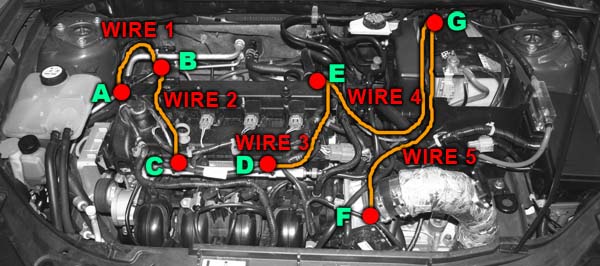
Okay guys, I picked up a nice multimeter at Sears tonight and took readings at the A-F points in the diagram here:


Battery Neg to Pos = .000 resistance
All of the following are Battery Neg to each point WITHOUT the kit:

A = 23.6
B = .000
C = .000
D = .000
E = .000
F = 2.755

These same points with the kit were ALL = .000

B is a bracket on the back left side of the engine, C & D are both ends of the fuel rail, and E is another bracket on the back right side of the engine...so all of those are totally grounded already. Point A is a bracket down on the left side of the engine that has a couple of what I believe are AC lines attached, for support and Point F is the throttle body (I believe that's what it's called anyway [the thing my Fujita intake attaches to]).

Obviously the TB to Battery Neg connection helps quite a bit, but I'm not really sure what the significance is of Point A being grounded even though it shows the highest gain. Anyone have any ideas? Is it possible that the other wires that connect from point to point across the engine bay are all in place to get Point A grounded better? I'm thinking it would be a lot less messing around to just go straight from Point A to Battery Neg and Point F to Battery Neg and call 'er a day. What are your thoughts? Please don't be a dick about it either, because I still stand by my original contention that I definitely noticed a difference in the overall feel and performance, but as Jay mentioned above, perhaps these numbers might give some insight into why I have that impression. I love cars, but I'm no mechanic so hopefully these numbers mean more to you than they do to me. All I get out of the numbers above is that .000 is very good and anything higher than that is bad, and the higher the number the worse it is...lol
 
A

aviateur

Guest
Uhh, battery neg to pos should be close to infinite resistance hopefully :) otherwise you'd have big issues.
 

YSOSLO

is the word, beotch
hmmm....no clue aviateur. All I know is what the reading said on the meter. According to the manual I was testing resistance in Ohms, but whether that impacts what you said or not I have no clue.
 

dmention7

Hater
Uhh, battery neg to pos should be close to infinite resistance hopefully :) otherwise you'd have big issues.
If he touched the positive probe of the multimeter to the negative battery terminal, and vice versa, the multimeter would likely read 0 ohms. If he reversed it, then he'd see infinite resistance. It's my understanding that they calculate resistance by measuring current at a given voltage... if that's not true, then yeah he should see infinite resistance either way.

Pete, when you get a chance, can you measure the voltages between those points with the engine idling?
 

YSOSLO

is the word, beotch
I just went out and checked the voltage at idle and Battery Neg to Pos is 13.92. I also double-checked the Ohms between the two and on my meter it blinks a couple of times fast and then shows a little picture of a batter with + and - and 0.000. The meter I get is this one http://www.sears.com/shc/s/p_10153_...hop&sName=Multi-Meters,+Testers+&+Accessories

Is it possible that the meter can tell I'm going from Pos to Neg on the battery, so it's showing me something funky? The user's manual wasn't any help deciphering the screen...no explanation of the battery icon. The 0.000 showed on there regardless of whether I switched the test leads around or not.
 

dmention7

Hater
Oh, I meant can you measure the voltage across the points in your engine bay at idle. Yeah, the voltage across your battery should be 12-14v at idle since that's what the alternator cranks out.
 

YSOSLO

is the word, beotch
I'll have to do that tonight. I've got to get goin' here, so I'm not late for work...lol
 

Big Nate

Chaos Engineer
Jay when he was at my house I checked everything with my meter with the engine at idle and there was no voltage drop at all between any point I could find on the car. If you only check at the points you put the kit. You would be checking wire continuity. That is very unlikely they would send you a wire that was broken.


Pete just to let you know you are not trying to measure the ohms with the car off. That should be 0 or else your battery would be dead all the time. You want to check it with the car running and just pick random spots and check that. Like anything that is bare metal on the car.

Place the positive (red end) of the meter on the positive terminal then put the negative end (black) end on any thing you want. Have the meter set to measure volts. You car has a 12 volt system but it will most likely be more then that (around 13-14 volts).
 

Workdawg

NARWHAL
I did a TB ground on my regular 3 after reading about it on M3F... I did read about how there was questions of weather it would work or not, but it cost me like 3$ to get a wire and some ring connectors at HD so I went with it. I honestly didn't notice a difference.

I also forgot to remove the wire before I turned the car back in after my lease was up, whoops. lol
 
Top